
Last updated: 16 October 2026
Psychoeducation · 6 min read
It’s late, and for the third time you type something like “neurodivergence counselling” into the search. On the screen: coaching, counselling, therapy, assessment, self-help. Everything sounds both right and not.
What you actually need is not another definition. But someone who places what fits your situation.
The term is vague – the question behind it is not.
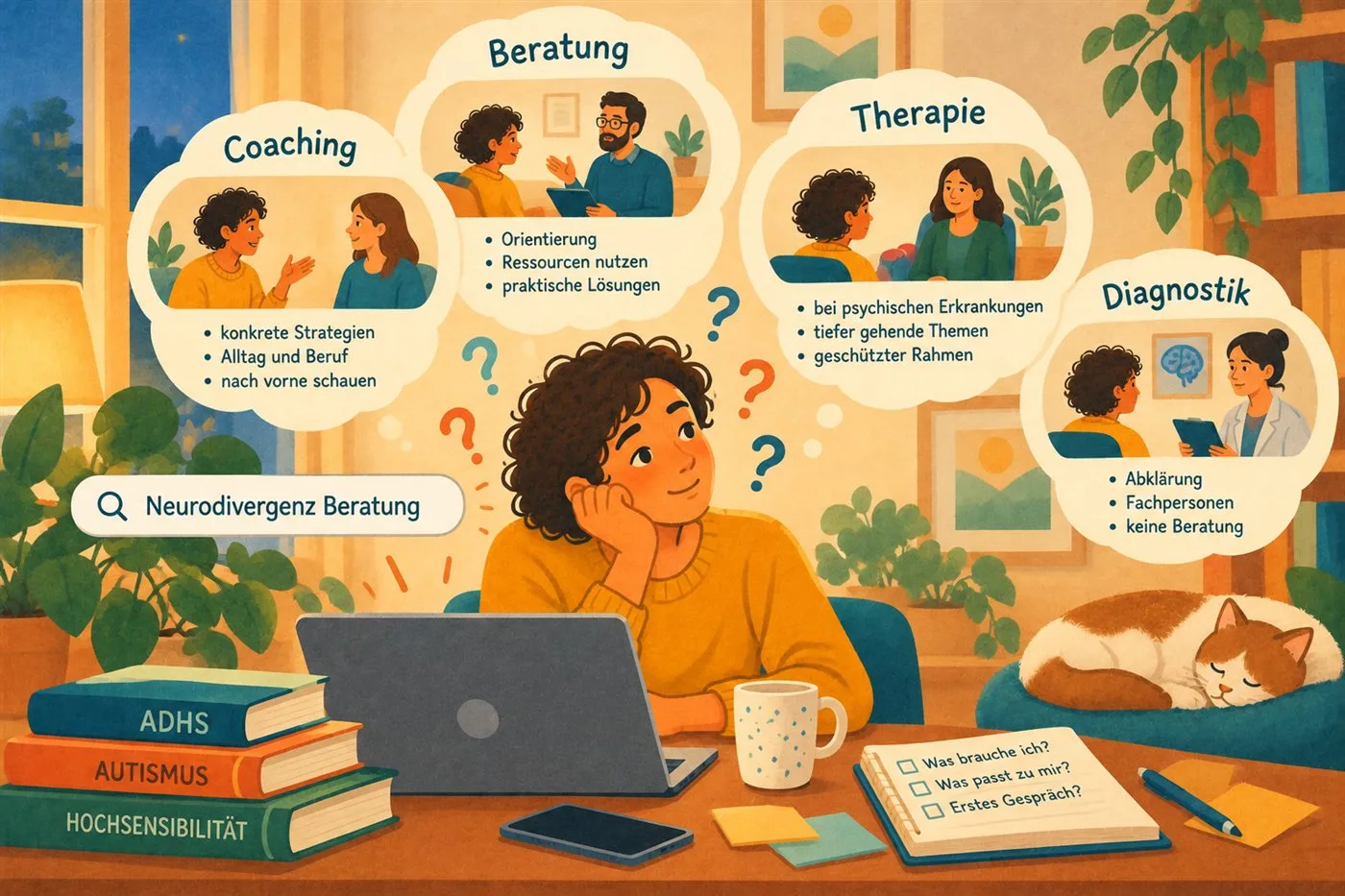
What “neurodivergence counselling” means
Neurodivergence counselling is not a protected term. It usually means support for people whose nervous system works differently (ADHD, autism spectrum, high sensitivity) and who keep hitting recurring limits in daily life, at work or in relationships.
The practical core is almost always the same: it is not about treating an illness, but about finding ways that fit how you think, feel and live. Structure that holds. Strategies for sensory overload. Orientation after a late diagnosis. Clarity in communication and boundaries.
In practice, “counselling” and “coaching” largely overlap. More important than the label is what actually happens, and where the boundary to something else runs.
Counselling, coaching, therapy – where the boundaries lie
The difference can be pinned to a single question: what is being worked on?
Coaching and counselling start from the present situation. They work with your resources on concrete concerns: how do I structure my week? how do I say what I need? how do I handle overload? The gaze goes forward.
Psychotherapy treats illnesses with clinical value – such as depression, anxiety disorders or the consequences of trauma. It may and should go where counselling deliberately does not, and it is bound to a corresponding training and licence.
Assessment, in turn, is again something of its own: whether a neurodivergence is present at all is evaluated by specialised professionals, not by counselling.
The transitions are fluid, and often both are needed, one after another or in parallel. What matters is that the frame is named honestly.
Whom it fits – and whom it fits less
Counselling fits well when, broadly, you are able to act, but keep running aground at certain points: the everyday that won’t hold; the exhaustion no one understands; the late diagnosis that reorders everything; the question of how to find your place in a world built for neurotypical people.
It is less suitable (or at least not as a first step) when an acute crisis, an untreated depression, addiction pressure or the after-effects of trauma are in the foreground. Then the protected frame of therapy is the right place, and serious counselling says so.
By the way, a diagnosis is not a requirement. Even with a mere suspicion (or none at all) you can work on your concrete situation.
How support actually unfolds
It usually begins with an initial consultation in which you clarify together what it’s about and whether the frame fits. After that, you work on concrete concerns, not on a rigid programme, but on what currently takes priority.
Neurodivergence-specific means: the setting itself takes your system into account. A calm, low-stimulation frame. No pressure to be “on topic” immediately. Pace and form follow you, not the other way round. At the end there is usually not a grand resolution, but a small, doable next step.
How to recognise good counselling
It is honest about its limits – what coaching can do and where another professional is responsible. It does not impose a goal on you but asks what you want. It does not treat neurodivergence as a defect but works with your system. And it promises no quick repair, because with these topics there is none.
If support feels like pressure to “function” more, it is the wrong one.
“You don’t have to know in advance whether you need counselling, coaching or therapy.
Finding that out is already part of the work.”
To put this in context
This article is an orientation, not a diagnosis or a treatment recommendation. Neurodivergence counselling and coaching are no substitute for psychotherapy or medical assessment. If you are in a crisis or under a health burden, please turn to the relevant professionals.
Continue reading
→ Neuroaffirming: What the word means – and why it makes the difference
→ Autism coaching for adults: what it can do – and what it can’t
→ Neurodivergent burnout: why you burn out even when everything looks normal from outside
If this concerns you
If you are stuck between the terms and not sure what you are actually looking for, that is a completely normal starting point – no reason to keep researching alone any longer.
In coaching with neurodivergent people we clarify exactly that together in the initial consultation: what fits your concern, and if something else is called for, we tell you honestly.
Who is writing? More about me and my own path with ADHD →