
Psychoeducation · 6 minutes reading time
What it’s about — in 30 seconds
Sensory overload is a result, not a cause. Two people can hit their limit in the same supermarket — and their nervous systems are answering two entirely different questions: «Is this processable?» or «Am I safe?»
This article shows four distinctions that hold up in everyday life — and why the answer «both» is true more often than «either/or».
You’re standing in the supermarket. Neon light, the hum of the fridge, a child fussing, three kinds of music at once, someone standing too close. After ten minutes your head is cotton wool, your irritability rises, you just want out.
Someone else is standing in the same supermarket and wants out just as much.
From the outside it looks identical. Inside, two completely different processes are running.
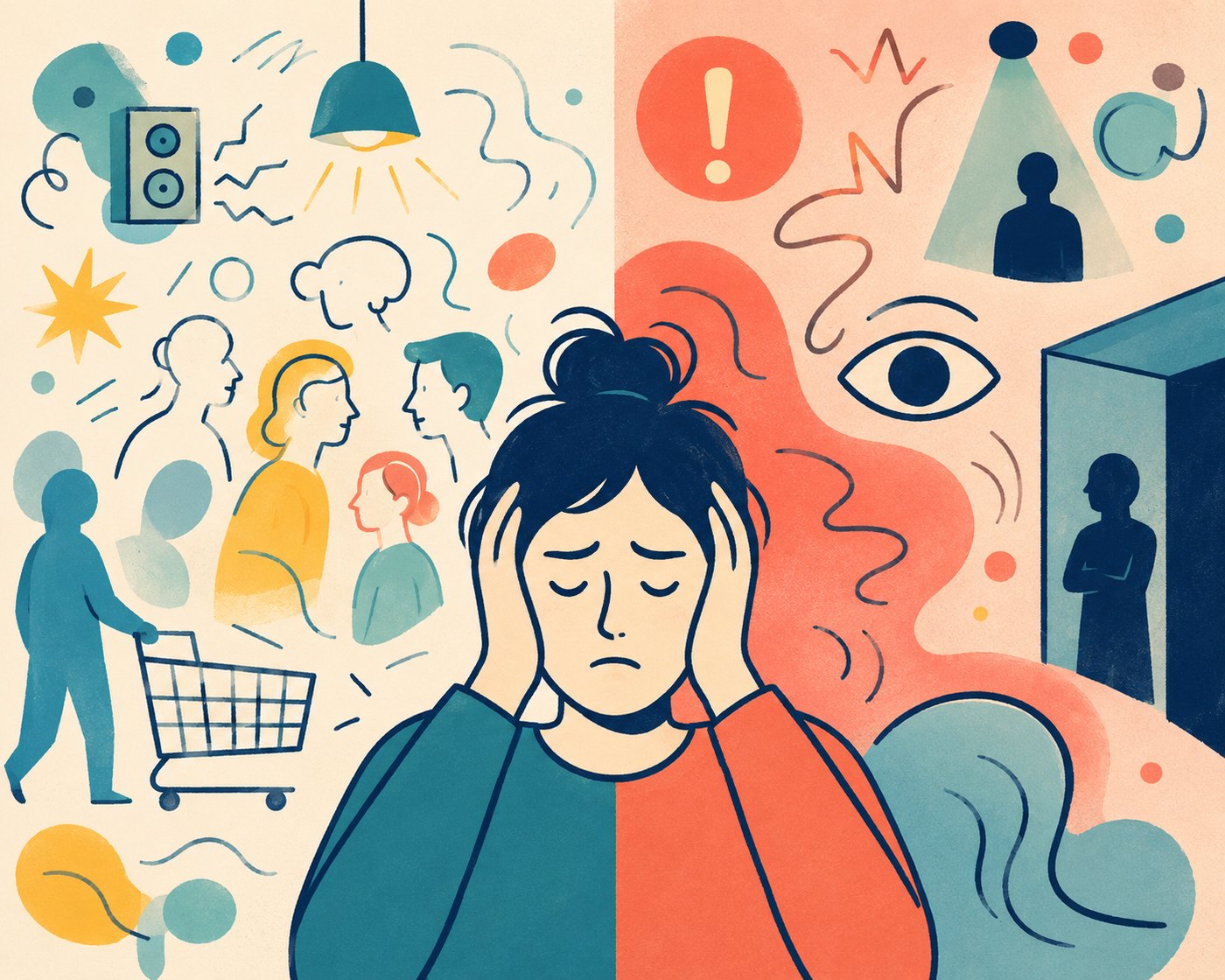
Two questions that look the same
Put simply, in demanding situations your nervous system asks one of two questions — and the answer determines what happens next.
«Is this processable?» — This is the question with sensory overload, common in AD(H)D, on the autism spectrum and with high sensitivity. It’s about quantity, pace, simultaneity. The system isn’t alarmed, it’s full. Like a bucket overflowing: there’s nothing threatening about the water — there’s just too much of it.
«Am I safe?» — This is the question with a trauma-related reaction. Here the system isn’t assessing quantity but danger. Something in the situation resembles — often without you being aware of it — something earlier. The system switches to protection before your mind can weigh in.
The behaviour can be the same in both cases: withdrawal, irritability, freezing, flight. The function behind it is fundamentally different — and so different things help.
In one sentence: Overload is a capacity problem, alarm is a safety problem — both look the same from the outside.
The dose or the cue?
The most practically useful distinction: Does your system react to the amount — or to a particular cue?
Sensory overload is usually dose-dependent. Ten minutes in the supermarket is fine, forty isn’t. One conversation works, four in a row don’t. There’s a threshold, and it shifts with your state: well-rested you tolerate more, after a bad night less. The curve is gradual.
A trauma-related reaction is usually cue-bound. It needs no dose. A particular tone of voice, a smell, a posture, someone between you and the exit — and it tips instantly, even if the situation is objectively harmless and calm. The curve is a switch, not a ramp.
So the question isn’t «how bad was it?», but: Was there a build-up — or was it suddenly there?
In one sentence: A ramp points more to overload, a switch more to alarm.
Since when — and where?
Two questions that clarify a surprising amount in practice:
Since when? Neurodivergent stimulus processing isn’t a phase. It’s been there as long as you can think back — even if you only found words for it late. A trauma-related reaction, by contrast, often has a before and an after. There was a time when the supermarket was simply a supermarket.
Where? Overload is unspecific: it hits you in the open-plan office, at the station, at the family gathering — everywhere too much happens at once. Alarm is selective: it hits you in particular constellations, while structurally similar situations stay completely uneventful.
So if you cope well with loud stations but reliably shut down during a certain kind of conversation — then «sensory overload» is probably not the full explanation.
In one sentence: Continuous and everywhere points to processing; from-a-point and in-places points to protection.
What helps afterwards reveals the most
The most honest test is retrospective: What actually helped you?
With sensory overload, less helps: getting out, headphones, a dark room, being alone, silence. Switch off the source and the system recovers — often surprisingly fast and fairly predictably.
With an alarm reaction, safety helps: a trusted person, a calm voice, knowing «it’s over», a place you control. Being alone in a dark room can even do the opposite here. And the after-effect lasts longer: it echoes for hours, sometimes days.
This distinction is so useful because it presupposes nothing. You don’t have to remember, interpret or read anything. You just look at what worked.
In one sentence: If silence helps, it was probably too much. If closeness helps, it was probably about safety.
And when both are true?
Then you’re in good company. The combination isn’t an exception but common — and there’s an understandable reason: whoever processes the world more intensely and had to function for years in environments that took no account of that gathers experiences that leave marks. Often it’s precisely those years of not-being-understood that made the nervous system cautious.
Then both patterns interlock: overload lowers the threshold for alarm, and alarm makes overload unbearable faster.
For practice this doesn’t mean «sort first, then act». It means: safety first. As long as a system is set to danger, the best stimulus reduction achieves little. Conversely, it’s hard to work on safety while the bucket is permanently overflowing. Both need their place — usually in that order.
In one sentence: From the outside, withdrawal is withdrawal. The only question that helps: from what — or from too much of what?
«From the outside, withdrawal is withdrawal.
The only question that helps: from what — or from too much of what?»
An honest word on classification
This article is not diagnostics and isn’t meant to give you any. The four distinctions are thinking tools, not criteria — they don’t replace an assessment or a professional.
And a clear boundary: trauma consequences belong in psychotherapeutic hands, not in coaching. If something in you said «yes, exactly that» while reading, the next step is a conversation with a psychotherapist — not with me. I’m glad to support you in making sense of it and finding the way there.
Read on
→ Autism, trauma or both? Seven points of confusion
→ ADHD or high sensitivity? Why the two get confused so often
→ Why «feel your body» doesn’t work for many neurodivergent people
If this topic concerns you
If you’ve spent years swinging between «I’m just overstimulated» and «there’s something else here», without ever getting clarity — then this distinction is often the point where something loosens.
In coaching with neurodivergent people it’s one of the first questions: not «how do we switch it off?», but «what exactly is happening here?»